Jeff Wheeldon spoke about the ‘Vital Signs’ report, which will be released next week. The report measures things we care about. The Vital Signs report will be released officially in Brighton at the Community Centre on Tuesday April 9th at 4pm.
The metric used by Government on the health of the state is the GDP. Generally as the GDP goes up, people are doing better. But GDP is measuring spending. If spending creates a mess and then spend more to clean up, GDP went up and people were working, but was life improved? During Vietnam, Canada made the napalm, so we made money.
Better metrics may be the World Happiness Index, which shows that the richest countries are not necessarily the happiest ones. The UN has ‘Sustainable Development Goals’ such as 'no poverty'.
Vital Signs looks at a more local level. The report is based on a comparison of statistics from 2016 to 2021 for Northumberland County.
As we all know, affordability is a major issue today, especially the cost of housing.. Housing should be less than 30% of the household income. The average household income in Northumberland is $72,000 annually. Homelessness is on the rise. Homelessness is a complicated issue and fixing it is complicated.
An example was given of a young couple that was making good salaries and purchased a home that they could afford. The husband became ill and could not work as before, so now they are counting down the days until they are homeless.
There is only one shelter in Northumberland County with 22 beds, however they have a list of 80 people that they know are homeless. The County just purchased another building adjacent to the current shelter, which will provide another 16 beds. Homelessness in Cobourg is very visible, and people are trying to survive without a home in the community. Seeing the homeless is also hard for the community to live with.
Not spending enough on homelessness upfront will cost more in the long run. This is the systemic analysis that Jeff wishes to put forward. The provincial government recently gave Cobourg $2.5 million to assist, but it is not enough.
One of the metrics measured is the number of farms, which has dropped by 10% over the past 4 years. As farmland increases in value, land is more valuable for real estate developments than for farming. Many foreigners and contractors are purchasing the land and holding it as an investment or for development instead of for farming. What will happen when all our land is owned by hobby farmers, marijuana growers, foreigners, investors, or others who are not farming?
The key message Jeff wishes to convey is that it is not just government programs that will solve the problems; rather, it is groups like Rotary who will give of themselves that are not recorded that will fill in all the gaps. We see that individual charity will not fill in all the gaps.
We are going through a drug crisis. The number of overdoses in the encampments is much less than in areas without encampments. In some ways, encampments are more successful than shelters due to the sense of Community, but no one is recording these metrics. So, the good work you are doing in the community may not show up, but it is very important.
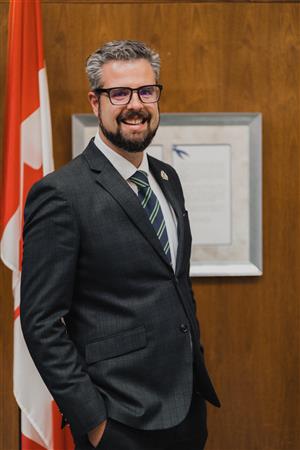
Jeff Wheeldon is a municipal councilor, realtor, and former member of this club. He lives in Brighton with his wife and two children, and spends most of his time trying to translate the four-way test and other worthy ideals into policy and programs. Most recently, he initiated and serves as the chair of the Northumberland Inter-Municipal Task Force on Housing and Homelessness.